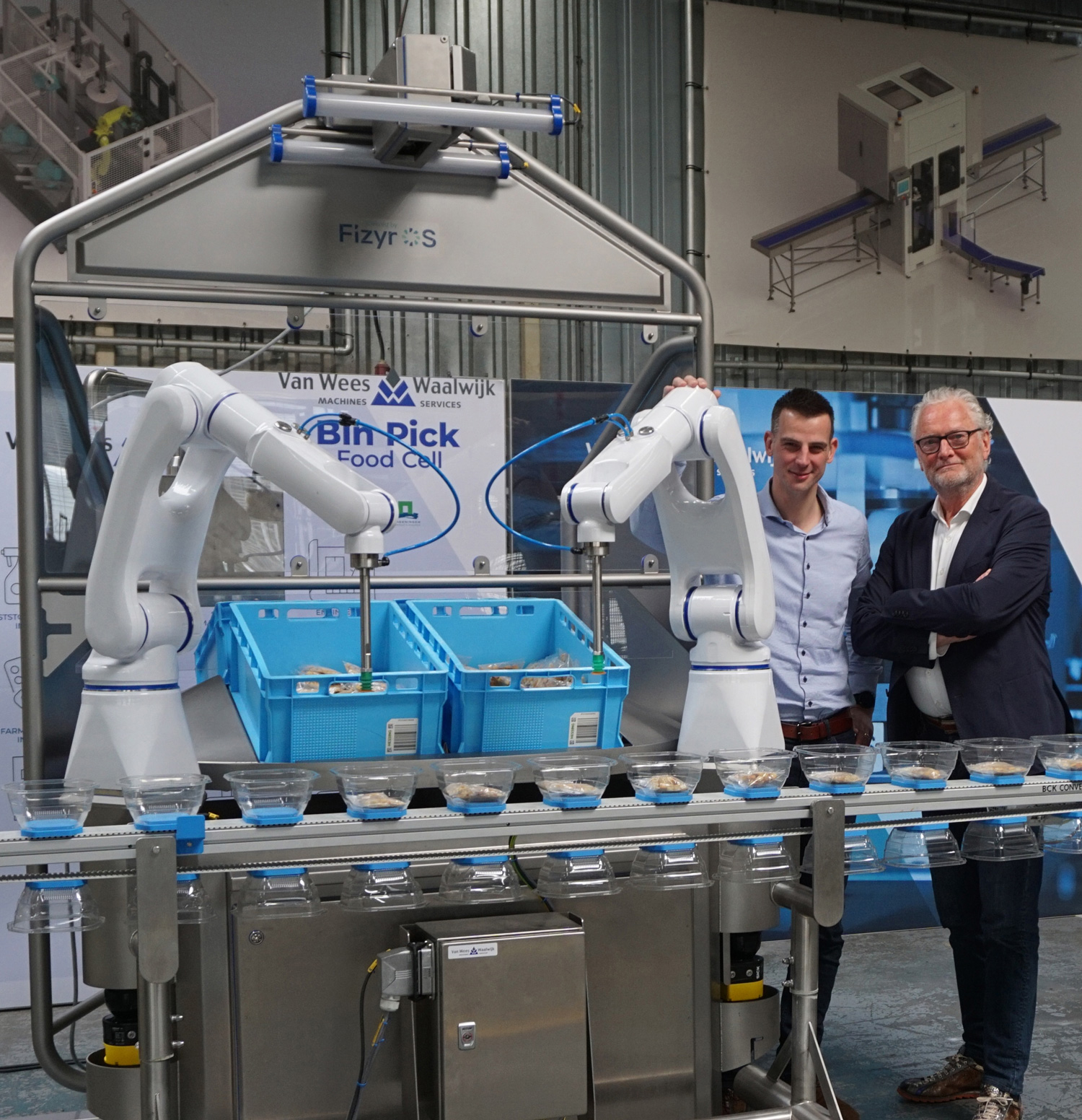
One of the developments addressing this need is the Bin Pick Food Cell from Van Wees Waalwijk: a mobile robot cell that is not tied to a single production line but can be deployed as flexible capacity across multiple lines. “In food processing, production capacity still relies heavily on manual labor, even though that labor is becoming increasingly unstable,” says owner-manager Andries van der Werf. In many factories, repetitive tasks, such as adding ingredients to meals, are still part of daily operations.
In the Dutch food industry, a significant portion of production capacity still relies directly on manual processes, such as adding ingredients, portioning, and packaging. This capacity is becoming less predictable due to labor shortages, product variation, and smaller batches. This not only affects staffing levels but also impacts delivery reliability and production costs.
Capacity under pressure
Traditional automation systems are typically designed for a single specific process step and a single product stream. While this makes these solutions efficient for high-volume production, they become less effective when dealing with variation or smaller batches. In such situations, production capacity is often idle or underutilized. The Bin Pick Food Cell was developed to address this issue. The cell is mobile and equipped with a docking system, allowing it to be deployed wherever capacity is needed.
This shifts automation from a fixed line investment to flexible production capacity. The cell operates with two robotic arms and processes, depending on the product and line speed, 40 to 60 “picks” per minute in cooled, hygienic environments with frequent product changes. “For repetitive tasks, part of the manual capacity can be taken over,” says Sjors van Haaren, sales engineer at Van Wees Waalwijk. “The extent to which this is possible depends on the product type, line configuration, and variation.”

Technology and Applicability
The use of such a cell is particularly relevant in environments characterized by high product variation, fluctuating volumes, and chronic labor shortages. In stable, high-volume processes, fixed automation remains more efficient in many cases. Consequently, the decision to automate increasingly requires a trade-off between maximum efficiency per line and flexibility at the factory level. Vision AI is used to handle unstructured products. For robot technology and vision software, we collaborate with partners such as Yaskawa and Fizyr. This combination makes it possible to automate products that were previously difficult to handle.
Simplicity and versatility
The cell is designed so that deployment and reconfiguration do not require specialized knowledge. This shifts the focus from reliance on scarce technical capacity to broader versatility. Whereas traditional automation is tied to a single production line, this cell can be deployed wherever capacity is needed. “Return on investment is determined not only by speed per line, but by deployability across multiple lines,” says Van der Werf. “That can also have implications for the business case.” As a result, the decision to automate becomes less of a purely technical optimization and more of a consideration of how production capacity is organized in the face of variability and labor shortages.
The technology will be showcased at the Food Tech Event on May 20 and 21 at the Brabanthallen in Den Bosch, among other venues.
This article was published in the "Future of Agri & Food" supplement of *Het Financieele Dagblad*.